Put a double-decker and an articulated bus side by side and they look like two answers to the same question: how do you move more people with fewer drivers? The resemblance ends quickly. One stacks passengers vertically on a rigid chassis. The other stretches them along a single deck with a joint in the middle. Which one belongs on your route has less to do with fashion than with kerb heights, corner radii, stop layout and the shape of your peak.
Start With the Route, Not the Vehicle
Operators who buy first and survey later usually regret it. Walk the corridor with a tape measure and a notebook before you commit to either type.
For a double-decker, the killers are height and weight. That means low bridges, tunnels, tram or trolleybus wires, tree canopy, low depot doors, and older workshops with overhead lifting gear. A branch that clears a standard bus by half a metre can peel a double-decker's upper windows off. Gradients matter too: a tall vehicle carries its weight high, so downhill braking and crosswind behaviour deserve a real test, not a brochure promise.
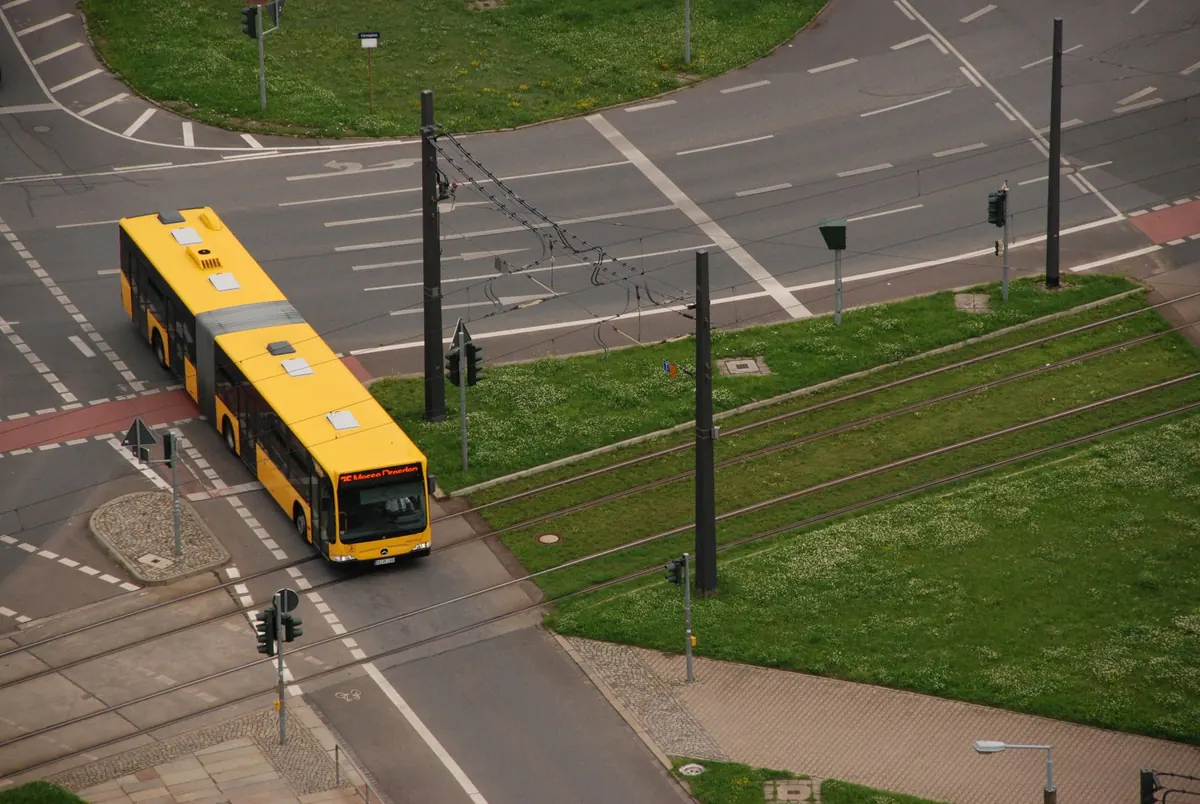
Articulated buses have the opposite problem. They are long, so they suffer at tight junctions, narrow lanes, tight service bays and any stop where the kerb is short. Look at every corner where a bus waits to turn across traffic. If the rear section would sweep into a cycle lane, a loading bay or a pedestrian island, the route will be painful every day.
Capacity: Seats, Standing and the Squeeze
Both vehicles are big, but they carry people differently. A double-decker typically offers something in the region of 70 to 90 passenger places depending on the model, seating layout, wheelchair space and whether it has two or three axles, and a large share of those places are seats. An articulated bus often has a higher total, but a much bigger slice of it is standing room along a single deck.
Which one you want depends on trip length. On a long suburban or interurban run, a seat is the product. Passengers will not stand for twenty minutes if they can help it, and a double-decker gives you more seats for every driver you pay. On a short city loop where most people ride three or four stops, standing room is fine and the articulated bus's flat floor is easier to load and empty.
There is a hard limit on the double-decker that planners forget: nobody climbs the stairs for two stops. On a high-turnover route, the upper deck sits half empty at midday while the lower deck is jammed. That is the worst of both worlds, and it is the clearest sign you have bought the wrong vehicle.
Turning Radius, Swept Path and Street Furniture
Brochure turning circles help nobody. What matters is the swept path: the whole area the vehicle occupies through a turn, including mirror overhang and rear tail swing.
A rigid double-decker is longer than a standard bus, so it needs more kerb-to-kerb radius at junctions, and its rear overhang swings wide as it turns. Drivers can judge that, because the vehicle is one piece. An articulated bus bends, which lets the rear axle track in more tightly than an 18-metre rigid vehicle would, but the trailer end still cuts in at the inside of the corner and the back corner swings out. Reverse manoeuvres are harder, and a jackknifed bus in a depot is a workshop problem, not a driving one.
Street furniture is the quiet cost. Bollards, signal poles, signposts, cycle lane wands, and badly placed shelters all get hit more often by long vehicles. Check the full swept path with a physical trial or a proper vehicle-tracking study. A morning with cones and a borrowed bus is cheaper than a year of panel damage.
Dwell Time: The Hidden Schedule Killer
This is where the two types diverge most, and where schedules are made or lost.
A double-decker usually boards through one door beside the driver, then the passenger climbs or walks aft. Anyone on the upper deck has to come downstairs before they can get off. At a busy stop, that converts a thirty-second stop into a ninety-second stop, and the queue of buses behind grows.
An articulated bus with three or four doors, all-level boarding and off-board or all-door fare collection can empty and refill in a fraction of that time. Standing passengers have somewhere to go, and wheelchair users board on a flat floor without depending on a stairwell being clear.
Two practical points follow:
- Fare collection changes everything. A double-decker with driver-only cash fares at a busy stop will always be slow. Off-board ticketing, tap-on at all doors or a conductor can transform it.
- Stop capacity is finite. One articulated bus fills a stop bay. Two will not sit side by side, so the second waits in the traffic lane and blocks general traffic.
Operating Cost: What Actually Drives the Numbers
Ignore sticker price and look at cost per passenger place delivered per hour. The main inputs are driver hours, energy, maintenance, tyres, insurance and depot space.
A double-decker wins on one line item above all: labour. One driver carries more seats, so if your peaks are directional and heavy, cost per seat can be attractive. It loses elsewhere. It is heavy, so it burns more energy per kilometre than a standard bus. It has larger tyres on many models, two decks of cleaning, stairwell and upper-deck wear, and it needs taller sheds and taller workshop access. Strike damage from a low bridge is expensive and blocks the route for hours.
An articulated bus carries more people in total but fewer in comfort, and its running costs are also above a standard bus: extra length, articulation joint servicing, a longer trailer to maintain, and more depot bay length. Its advantage is fleet commonality. Many operators find that the practical alternative to an articulated bus is simply two standard single-deckers, which costs one extra driver but gives flexibility, easier maintenance and two vehicles at times when only one is needed.
Local fuel and energy prices, wage rates and fleet scale swing these numbers enough that generic figures from another city are close to useless. Build your own model with your own labour rates, your own depot constraints and your own load profiles.
A Quick Decision Checklist
Run through these before you shortlist anything:
- Peak passengers per direction, and average trip length in stops or minutes.
- Low bridges, tunnels, wires and tree canopy on the route, plus depot door heights.
- Tightest junction turning radius and expected tail swing, checked as a swept path.
- Stop layout: bay length, kerb height, shelter position, room for all-door boarding.
- Depot capacity: bay length for a long vehicle, shed height for a tall one, wash and workshop access.
- Passenger mix: wheelchair users, strollers, older riders, school groups, tourists.
- Labour versus energy costs in your market, and whether one extra driver per peak trip is affordable.
- Fleet commonality with what you already own, service and stock parts for.
Trial Before You Commit
Borrow or short-lease one of each and run them on the worst street in the corridor, not the easiest. Time the dwell at your busiest stop with a stopwatch. Count how many people actually go upstairs. Ask drivers which one they would rather take through the tight junction at five in the afternoon, and ask them again after a wet week.
Most successful networks end up with both, deployed where each makes sense: double-deckers on long, limited-stop, seated-demand corridors and park-and-ride feeders, articulated buses on high-turnover urban routes with level boarding and fast ticketing. Match the vehicle to the job, keep the trial honest, and the route will pay for itself in reliability rather than in headlines.
Photo: Enrico Hänel / Pexels